artificial grass
sales
commercial

One of the most common mistakes companies make when approaching AI is starting with tools before starting with structure.
The logic sounds reasonable at first.
A team wants better content generation, so they test AI writing tools.
Sales wants automation, so they look at CRM add-ons.
Operations wants visibility, so they connect dashboards.
Customer service explores chat and response systems.
Finance wants forecasting support.
Leadership wants reporting and decision assistance.
Each request sounds valid.
But when every department starts evaluating tools independently, the company creates a bigger problem before it solves the first one.
It creates a fragmented AI environment built on fragmented operational logic.
That is why one of the most important decisions an enterprise can make before expanding its AI stack is this:
What is our core business system?
Until that question is answered clearly, AI adoption tends to remain expensive, inconsistent, and difficult to scale.
A core business system is not just another software subscription.
It is the system that acts as the operational center of gravity for the business.
It is where teams align around the most important records, workflows, statuses, and decisions.

In some organizations, this may be a CRM such as HubSpot or Salesforce.
In others, it may be a project or workflow platform such as Monday.
In more operationally mature businesses, it may be an ERP or another internal system of record.
The exact platform matters less than the function it serves.
The core system is the place that answers questions like:
If the business cannot answer these questions clearly, then adding more AI tools usually creates more confusion rather than more capability.
Before AI, fragmented systems were already a management problem.
Now they are a scaling problem.
AI depends on structure. It needs defined inputs, clear records, stable workflows, and trusted business logic.
If the company has three systems that all claim to own the customer record, AI will not solve that conflict.
If lead data enters through multiple disconnected forms and is categorized differently in different teams, AI will not reliably improve the process.
If proposal data, finance data, and customer communication all live in separate silos without clean synchronization, AI outputs will stay partial, inconsistent, or misleading.
AI becomes valuable when it sits on top of a business that knows where truth lives.
That is why choosing a core system is not an IT detail. It is a strategic decision.
When no system is clearly established as the operational center, organizations start making local decisions instead of enterprise decisions.
Marketing optimizes around its own tools.
Sales organizes around its own records.
Operations tracks work in a different environment.
Finance uses separate logic.
Service teams create parallel workflows.
Over time, the business develops multiple versions of reality.
One platform says a deal is active.
Another says it is stalled.
A spreadsheet says pricing changed.
A proposal tool reflects something else.
A finance platform shows a different outcome after the fact.
At that point, leadership no longer has a reliable foundation for automation, reporting, or AI-enabled decision making.
The company may still operate. Many do.
But it becomes much harder to scale cleanly because every new automation has to guess which source to trust.
That is not an AI problem. That is a systems hierarchy problem.
The wrong sequence looks like this:
This happens often because AI adoption feels exciting and urgent.
But speed without system logic creates technical clutter and management drag.
The result is not transformation.
It is tool accumulation.
The stronger sequence is more disciplined:
This approach may look slower at the beginning.
In practice, it is faster where it matters, because it reduces rework, duplicate tooling, and failed pilots.
It also gives leadership a way to evaluate whether AI is improving the business or simply creating more activity.
Most growth-oriented companies already have multiple systems in place. The question is not whether they should use multiple systems.
They should.
The question is how those systems should be organized.
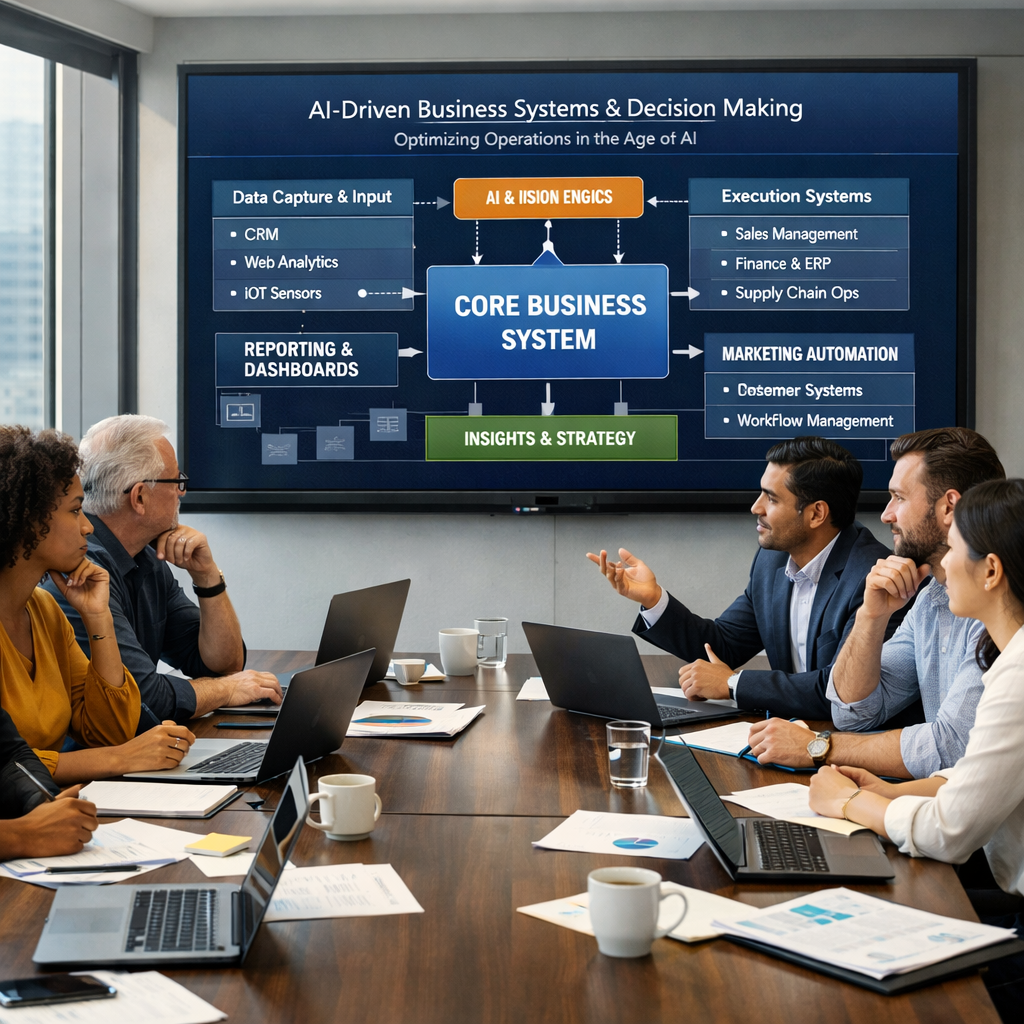
A simple way to think about the stack is this:
These are the tools that collect information from the outside world.
Examples:
This is the main operational platform where the organization tracks the most important records and workflow stages.
Examples:
These are the tools used to act on the workflow.
This is where AI and automation begin to add leverage.
Examples:
This includes dashboards, reports, and management visibility across the operating model.
If these layers are not aligned, AI gets deployed into the gaps.
If they are aligned, AI becomes far more useful and governable.
There is no universal answer. The right core system depends on how the company actually operates.
But the decision should be based on operational reality, not personal preference or vendor enthusiasm.
The right core system is usually the one that best supports:
For a sales-driven organization, that may be a CRM.
For an operations-heavy company, it may be a workflow or project system.
For a mature enterprise, it may be something deeper in the operating infrastructure.
The key is not to ask, “Which tool is best?”
The key is to ask, “Which system should sit at the center of how this business runs?”
That is the question leadership must answer before AI scale becomes realistic.
Choosing the core system early creates several advantages.
First, it clarifies where process discipline needs to happen.
Second, it makes integrations more intentional.
Third, it reduces duplication.
Fourth, it gives AI a more stable environment to work in.
Fifth, it allows leadership to evaluate pilots against real workflow outcomes.
Without this decision, many AI projects become disconnected productivity experiments.
With it, AI can start becoming part of the operating model.
That is the difference between scattered innovation and structured transformation.
Before a company expands its AI tools, it should make one leadership decision very clearly:
Which system sits at the center of how the business operates?
That decision influences data quality, workflow design, reporting trust, automation logic, and AI effectiveness.
Many organizations do not need more AI tools first.
They need a stronger systems hierarchy.
Because once the core business system is defined, the rest of the AI roadmap becomes easier to design:
That is where enterprise AI becomes more than experimentation.
That is where it begins to become operational.
Provendude helps companies define the system structure behind effective AI adoption.
Before adding more tools, we help leadership identify the core operating system, map workflow ownership, structure integrations, and prioritize the AI initiatives that can create measurable value.