catalogue
supplier
proposals

Most companies are asking the misleading question about AI.
They ask:
“Can AI write proposals for us?”
But the answer lives in a different question.
“Is your business system structured well enough for an AI agent to operate it?”
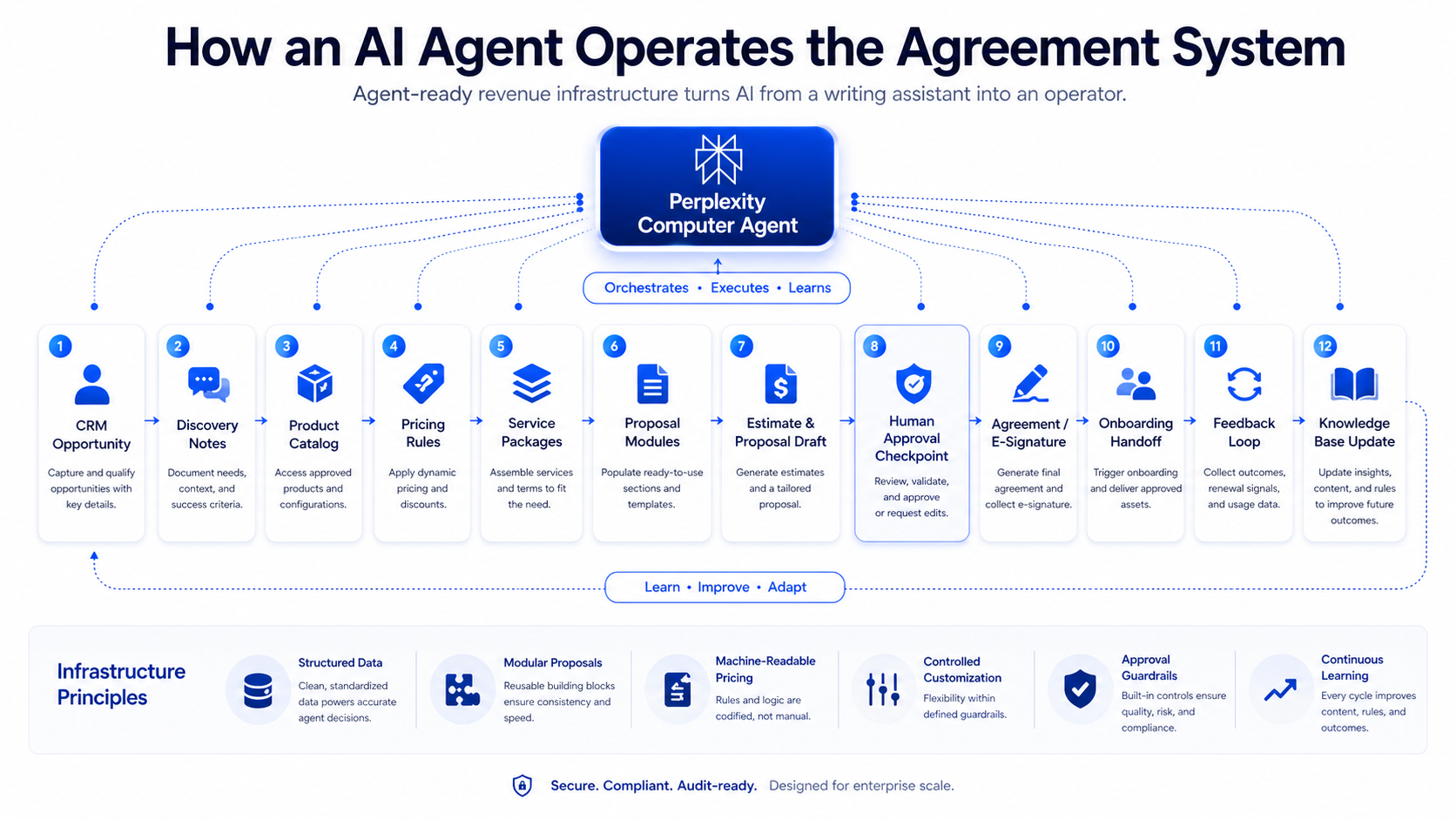
Because the future is not just AI writing emails, summaries, or proposal text. The future is an AI agent reading the opportunity, checking the CRM, reviewing customer notes, applying pricing rules, selecting the right package, adding service options, preparing the proposal, routing it for approval, and triggering the next step after signature.
That is a completely different level of automation. But it only works if the system is built correctly.
An AI agent cannot efficiently operate a business where pricing is hidden in spreadsheets, proposal language is buried in old emails, service packages are not standardized, approvals happen by text message, and the best sales knowledge lives only in people’s heads.
AI does not fix chaos.
AI operates a structure.
That is why the next advantage will not belong to companies that simply “use AI.”
It will belong to companies that redesign their revenue infrastructure so AI agents can operate it.
Many companies already have the pieces.
They have:
They have experienced people who know how to position the product, handle objections, and build trust with customers.
But all of this knowledge is usually scattered.
Some of it is in the CRM. Some of it is in spreadsheets. Some of it is in PDFs. Some of it is in someone’s inbox. Some of it is in Slack messages. Some of it is in the head of the best salesperson. Some of it is in the service manager’s memory.
That creates a major problem:
The company may have knowledge, but it does not have a system.
And if there is no system, an AI agent cannot operate reliably. It can guess, draft, summarize, and suggest. But it cannot run the process with high confidence.
It cannot know:
Unless that information is structured and accessible, the agent gets stuck.
Many companies think AI transformation means giving employees a chatbot.
That can be useful, but it is not enough.
A blank AI chat box still depends on the user knowing what to ask. It still depends on the user finding the right information, checking the output, understanding the rules, and manually moving the process forward.
That is assistance.
It is not true automation.
The real future is a structured revenue system where the AI agent has access to:
In that system, the agent is not just writing.
It is operating.
It can move work from one stage to another, assemble estimates, recommend packages, check margins, prepare agreements, alert managers, update the CRM, and capture feedback after the deal.
That is when AI becomes useful at the business-process level.
It stops being a writing tool and becomes part of the operating system of the company.
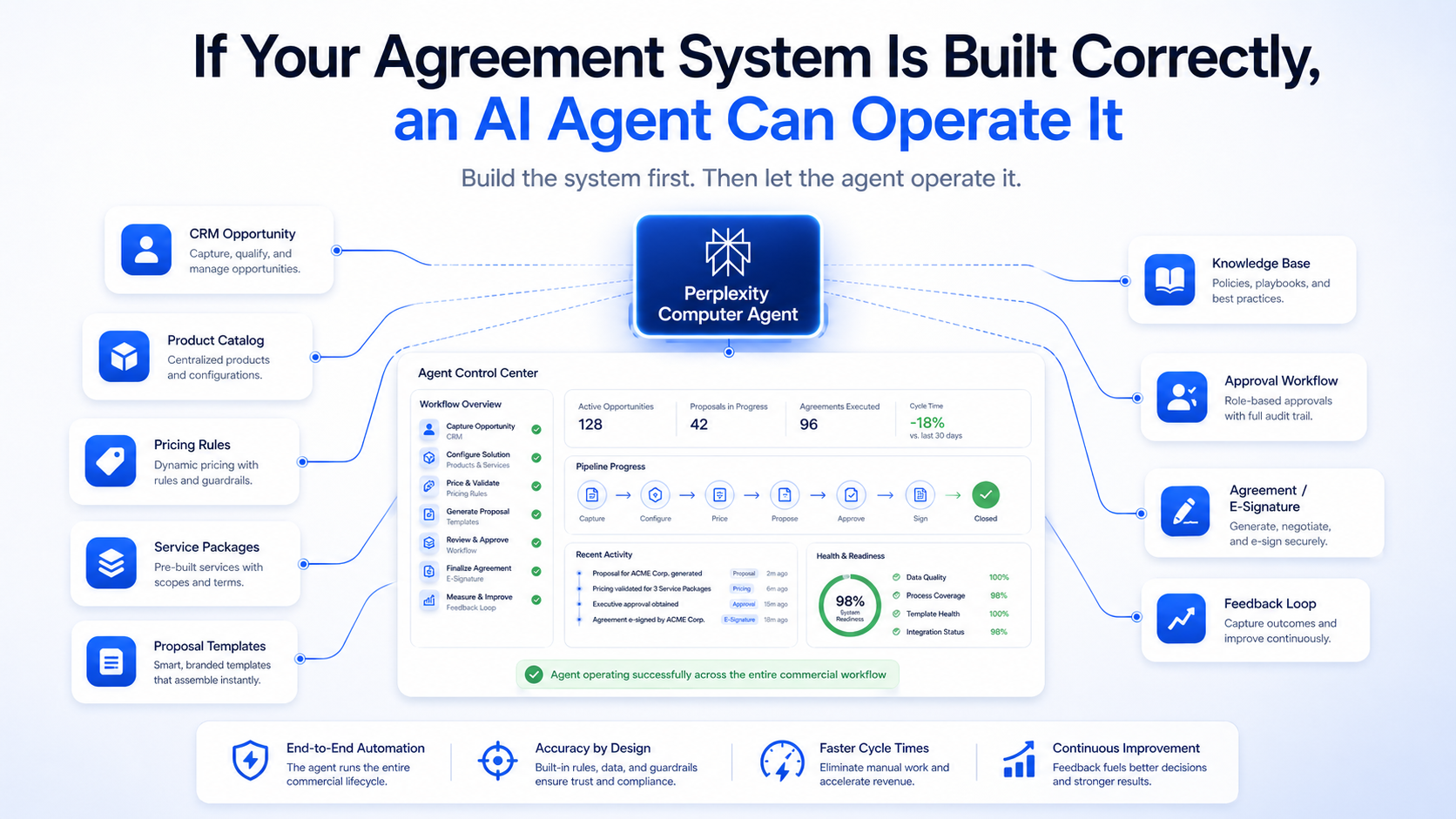
An agent-ready agreement system is not just a proposal template.
It is not just CRM.
It is not just estimating software.
It is a structured commercial workflow that connects customer information, product knowledge, pricing logic, proposal language, approval rules, and signed agreements into one operating environment.
At a minimum, it should include:
Once those pieces are organized, an AI agent can begin to operate the process.
For example, the agent can read a customer opportunity and understand who the customer is, what they need, what they asked for, what products or services apply, what package should be recommended, what add-ons make sense, what risks need to be explained, what local trust-building language should be included, what approval is required before sending, and what happens after the customer signs.
That is the difference between AI as a writing assistant and AI as a revenue operator.
The agreement system is one of the best places to start because it sits at the center of revenue.
It connects:
A weak agreement system creates confusion.
A strong agreement system creates clarity.
A strong agreement system tells the customer:
When this structure is clear, it becomes much easier for an AI agent to help.
The agent can assemble the right version of the agreement instead of inventing one from scratch. It can use approved modules, apply pricing rules, add the right service sections, suggest add-ons, personalize the customer summary, and route the agreement for review.
The stronger the agreement system, the more useful the agent becomes.
Do not start by asking:
“Which AI tool should we use?”
Start by asking:
“What process do we want the agent to operate?”
If the process is unclear, the AI will only make the confusion faster. It may generate more content, but that content will still need to be checked, corrected, priced, approved, and manually organized by people.
Before adding an AI agent, the company should define:
The agent needs rails.
Without rails, it improvises.
With rails, it operates.
This is one of the biggest misunderstandings about AI. Companies often expect AI to solve the workflow problem. In reality, AI performs best when the workflow has already been designed.
The cleaner the process, the more confidently the agent can act.
Most proposals should not be written from scratch every time.
They should be assembled from approved modules.
A strong modular proposal system may include:
This makes proposals easier for humans to build and easier for AI agents to assemble.
Instead of asking AI to write a random proposal, the system can instruct the agent to use the approved introduction, apply the correct package structure, use the current pricing logic, include the approved warranty language, add the right local trust section, and follow the correct approval path.
That creates consistency.
It also reduces risk.
The agent is not inventing the business from scratch each time. It is assembling a controlled proposal from building blocks the company already trusts.
A good system should not allow everything to be customized.
Some parts should be controlled:
These are the areas where inconsistency creates risk.
Other parts should be flexible:
These are the areas where personalization creates value.
This is important because AI agents are powerful, but they need boundaries.
The goal is not to let the agent invent everything.
The goal is to let the agent personalize within approved guardrails.
That is how a company can get both speed and control.
Pricing is where many AI systems break.
If pricing rules are scattered across spreadsheets, old quotes, manager memory, and handwritten exceptions, an AI agent cannot price reliably.
It may create a proposal that looks professional, but:
The system needs clear pricing logic.
That may include:
The agent should not guess the price.
It should apply the rules.
If a human needs to approve an exception, the system should route it for approval.
That is how automation protects margin instead of destroying it.
The goal is not only to make proposals faster. The goal is to make them more accurate, more consistent, and more profitable.
The knowledge base is the brain of the system.
It should include more than product documents.
It should capture the company’s actual selling knowledge:
This knowledge base should not be static.
It should improve every time the company sends a proposal, wins a deal, loses a deal, receives an objection, updates a product, or changes a service rule.
The feedback loop is what makes the system smarter.
Without a feedback loop, every proposal is a one-time event.
With a feedback loop, every proposal improves the next one.
Over time, the company stops relying only on individual talent and starts building organizational intelligence.
The goal is not to remove humans from every decision.
The better model is:
Agent prepares. Human approves. System learns.
The agent can do the heavy work:
But managers and salespeople should still approve important decisions, especially:
This creates a practical system.
It saves time without creating unnecessary risk.
The best AI-enabled sales system is not uncontrolled automation. It is structured automation with smart checkpoints.
The agent handles the repetitive work, the system enforces the rules, and humans focus on judgment, relationships, and exceptions.
An agent-ready revenue system should have a clear path from opportunity to signed agreement.
A simple version looks like this:
This is the real value.
Not one isolated AI task, but a connected workflow.
The more connected the workflow becomes, the more the agent can do. The agent can move from task completion to process operation.
This is also where most companies need to rethink their software stack. CRM, proposal tools, estimating tools, e-signature, knowledge base, and project handoff cannot remain completely disconnected.
They do not need to be perfect on day one.
But they need a clear operating logic.
For an artificial turf company, an AI agent could help create estimates and proposals if the revenue system is structured correctly.
The agent could review:
Then it could prepare:
The salesperson or manager would still review the output, but the amount of manual work would be dramatically reduced.
But this only works if the company has already organized the required information.
If turf pricing is unclear, labor rules are inconsistent, and proposal language changes every time, the agent will get stuck.
The agent needs a system.
For a supplier or manufacturer, the same principle applies.
The agent could help a sales team prepare commercial proposals for dealers, contractors, factories, or enterprise buyers.
It could recommend:
But again, the AI agent cannot magically know what the business has never structured.
The company must turn its sales logic into a system. That means defining the packages, organizing the catalog, controlling the language, mapping the approval process, and capturing the knowledge from past deals.
This is especially important for companies with dealer networks, regional sales teams, or complex product lines.
The more complexity there is, the more valuable an agent-ready system becomes.
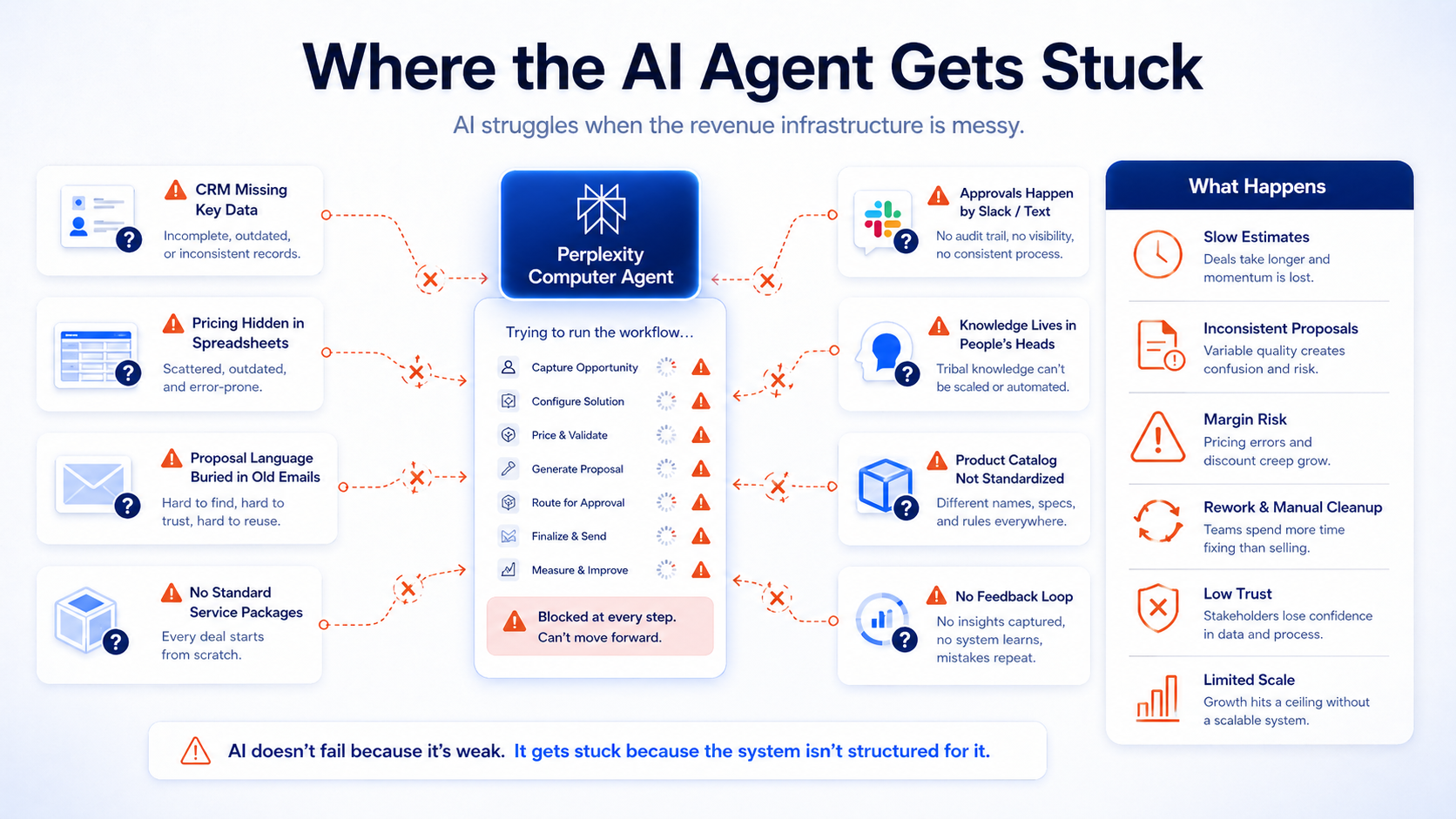
An AI agent gets stuck when the infrastructure is messy.
Common blockers include:
When that happens, the result is predictable:
The AI does not fail because it is weak.
It gets stuck because the system is not structured for it.
This is why companies should not judge AI only by what it can do inside a messy workflow. They should ask what it could do if the workflow were designed properly.
Companies should stop thinking about AI as a separate tool and start thinking about AI as an operator that needs infrastructure.
The practical steps are straightforward:
This is not just automation.
This is commercial system design.
It requires thinking through how revenue actually moves through the company, from lead to estimate, from estimate to proposal, from proposal to agreement, and from agreement to delivery.
The companies that do this work will have a major advantage.
They will not just have AI tools.
They will have systems that AI can operate.
In the past, sales infrastructure was mostly administrative.
CRM was where salespeople logged activity. Proposal software was where documents were created. Spreadsheets were where pricing was calculated. Managers reviewed deals manually. Operations received handoffs after the sale.
But with AI agents, sales infrastructure becomes much more important.
It becomes the operating environment.
The cleaner the system, the more the agent can do.
The messier the system, the more the agent gets stuck.
That is why companies should not only ask:
“How do we use AI?”
They should ask:
“How do we make our business agent-ready?”
That question leads to better CRM design, better proposal templates, better pricing logic, better approval workflows, and a better knowledge base.
At ProvenDude, we believe the next generation of revenue growth will come from structured systems that combine:
This is especially powerful for suppliers, contractors, manufacturers, dealer networks, and service businesses.
These companies already have the knowledge. They already have the products. They already have the customer demand.
What they often lack is the structure that turns all of it into a repeatable revenue system.
Once that structure exists, AI agents can begin to operate the process.
That is the real opportunity.
Not AI as a toy.
Not AI as a writing assistant.
AI as an operator inside a well-built commercial system.
The companies that win with AI will not necessarily be the companies with the most tools.
They will be the companies with the cleanest revenue infrastructure.
Their catalogs will be structured. Their pricing rules will be clear. Their proposals will be modular. Their knowledge base will be alive. Their approval process will be defined. Their CRM data will be usable. Their feedback loop will improve the system over time.
Then an AI agent can do what agents are supposed to do:
Operate the process.
The future does not belong to companies that simply use AI. It belongs to companies that build systems AI can operate.