artificial grass
sales
commercial


Many companies approach AI from the middle.
They start with use cases.
They start with tools.
They start with pilots.
They start with automation ideas.
That is understandable. It is also why many initiatives become harder to scale than expected.
Because AI does not become valuable simply because it exists inside the business.
It becomes valuable when it is connected to a clear operational path:
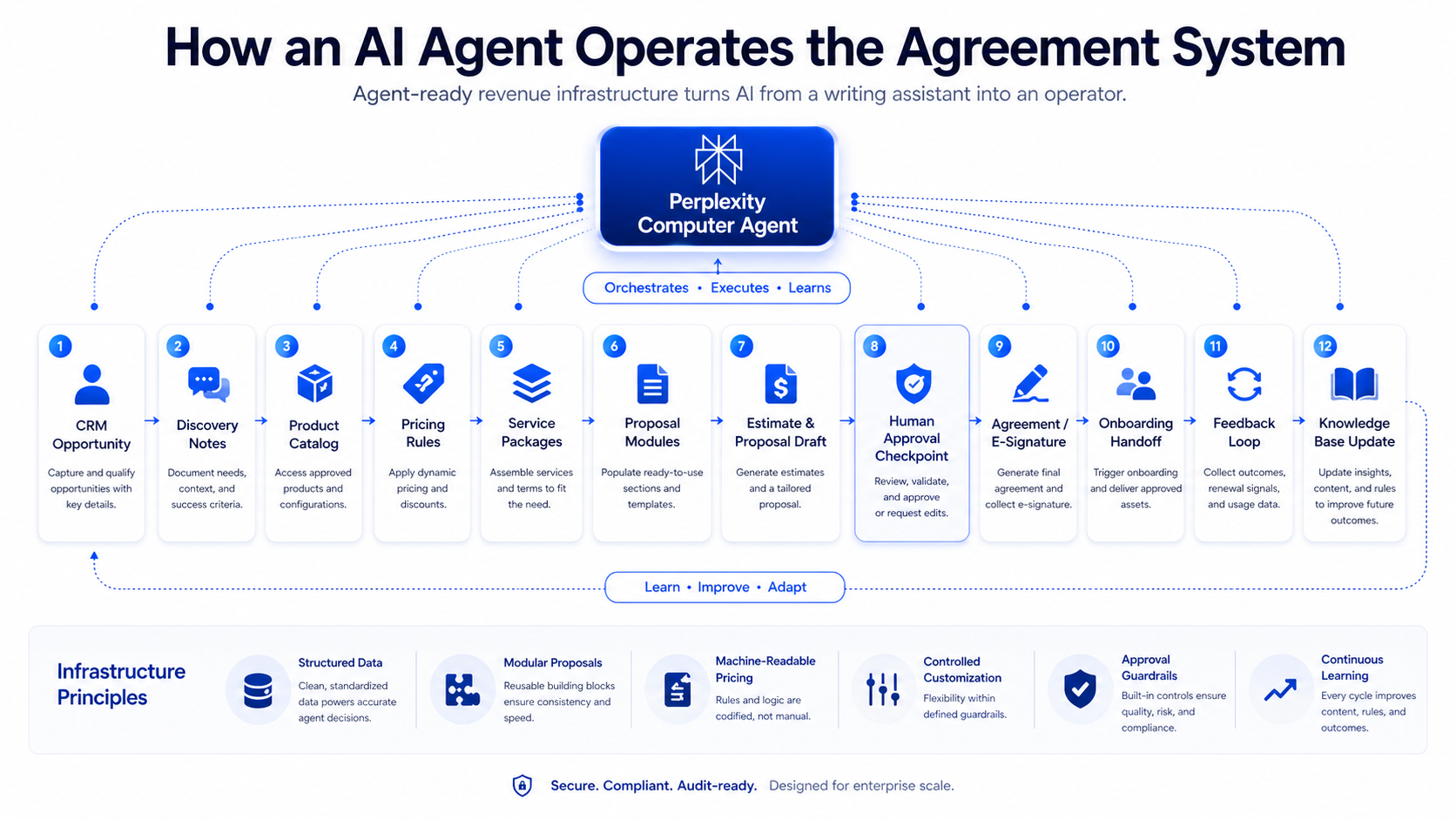
data capture → system structure → workflow execution → intelligence → measurement
That sequence matters.
Without it, companies often end up with disconnected tools, partial automations, and outputs that are difficult to trust.
With it, AI becomes part of how the business actually operates.
That is why enterprise AI should be approached as a roadmap, not a collection of experiments.
Most organizations already have the raw ingredients for AI.
They have:
The problem is not usually lack of components.
The problem is lack of sequence.
When the business does not define how information should move from capture to action to visibility, AI tends to sit in isolated pockets.
One team uses it for content.
Another uses it for summaries.
Another uses it for drafting.
Another wants forecasting.
Another wants service automation.
All of that can be useful.
But if those efforts are not built into a common operating model, the enterprise gets activity without alignment.
That is why a roadmap matters.
It creates order around what should happen first, what should connect next, and what should be measured before scale.
Every AI system depends on inputs.
If the inputs are weak, the outputs will be weak.
If the inputs are inconsistent, the outputs will be unreliable.
If the inputs are missing structure, the outputs will require too much cleanup to become operationally useful.
That is why the roadmap starts with data capture.
This is where companies should ask:
This stage includes systems such as:
The purpose of this stage is not to collect more data.
It is to collect the right data in a way that can support real workflow decisions later.
Many AI efforts underperform because the organization tries to automate before it has disciplined the intake layer.
That is like trying to accelerate a process that still does not know what it is receiving.
Once information enters the business, it has to land somewhere that matters.
This is where the core business system becomes critical.
The point is that the business chooses where official records live and how workflow statuses are managed.
At this stage, leadership should define:
Without this step, AI gets deployed on top of conflicting sources of truth.
That creates inconsistency, mistrust, and duplicated effort.
With this step, the company creates a structure that AI can support more reliably.
Once data is captured and the core system is defined, the next question is simple:
How does work actually happen?
This is where execution systems come in.
Examples include:
This stage matters because AI should not be designed in the abstract.
It should be designed around workflows that already create business outcomes.
For example:
That is a business flow.
And AI becomes powerful when it improves parts of that flow with precision.
Not by replacing the business, but by making key moments faster, cleaner, and more scalable.
Only after the first three stages are clear should the company expand the AI layer.
This is where AI should support the business in targeted ways.
Examples include:
This is the stage most companies want to start with first.
But AI creates better results here when the earlier stages are already structured.
Why?
Because AI works best when it knows:
At that point, AI moves from “interesting output” to “useful operating support.”
That is a major shift.
This is the stage many companies underestimate.
They focus on deployment, but not enough on proof.
For enterprise AI to gain trust, it must be measurable.
Leadership needs to know:
This is where dashboards, management reviews, and success metrics become essential.
Without measurement, AI remains anecdotal.
With measurement, it becomes strategic.
A company does not scale AI because employees say it feels useful.
It scales AI because leadership can see that it is improving execution, control, speed, or economics.
When enterprises skip the roadmap, a predictable set of problems appears.

If they skip structured data capture, AI receives messy inputs.
If they skip core system design, AI acts on fragmented records.
If they skip workflow clarity, AI supports inconsistent processes.
If they skip measurement, AI adoption becomes hard to justify.
In other words, the business may still be “using AI,” but not in a way that creates reliable enterprise value.
This is why some companies feel stuck in pilot mode.
They are testing capabilities without completing the operational path that makes those capabilities scalable.
How Enterprises Should Use This Roadmap
The roadmap does not mean every company must solve everything at once.
It means they should think in the right order.
A practical approach often looks like this:
This gives leadership a way to move with discipline instead of reacting to every new tool or trend.
It also helps separate real transformation from scattered experimentation.
Enterprise AI does not begin with prompts. It begins with operating logic.
The companies that get the most value from AI will not simply be the ones that adopt tools the fastest.
They will be the ones who create the clearest path from:
data capture → system structure → workflow execution → intelligence → measurement
That is the roadmap.
And once that roadmap is in place, AI stops being a disconnected initiative.
It starts becoming part of how the enterprise runs.
ProvenDude helps organizations design the roadmap behind effective AI adoption.
We work with leadership teams to structure the data flow, define the core systems, map workflows, prioritize use cases, and build AI initiatives that can be measured and scaled.